Helping an Energy Corporation Rebuild its Platform, Accelerated 48% by Agentic Delivery
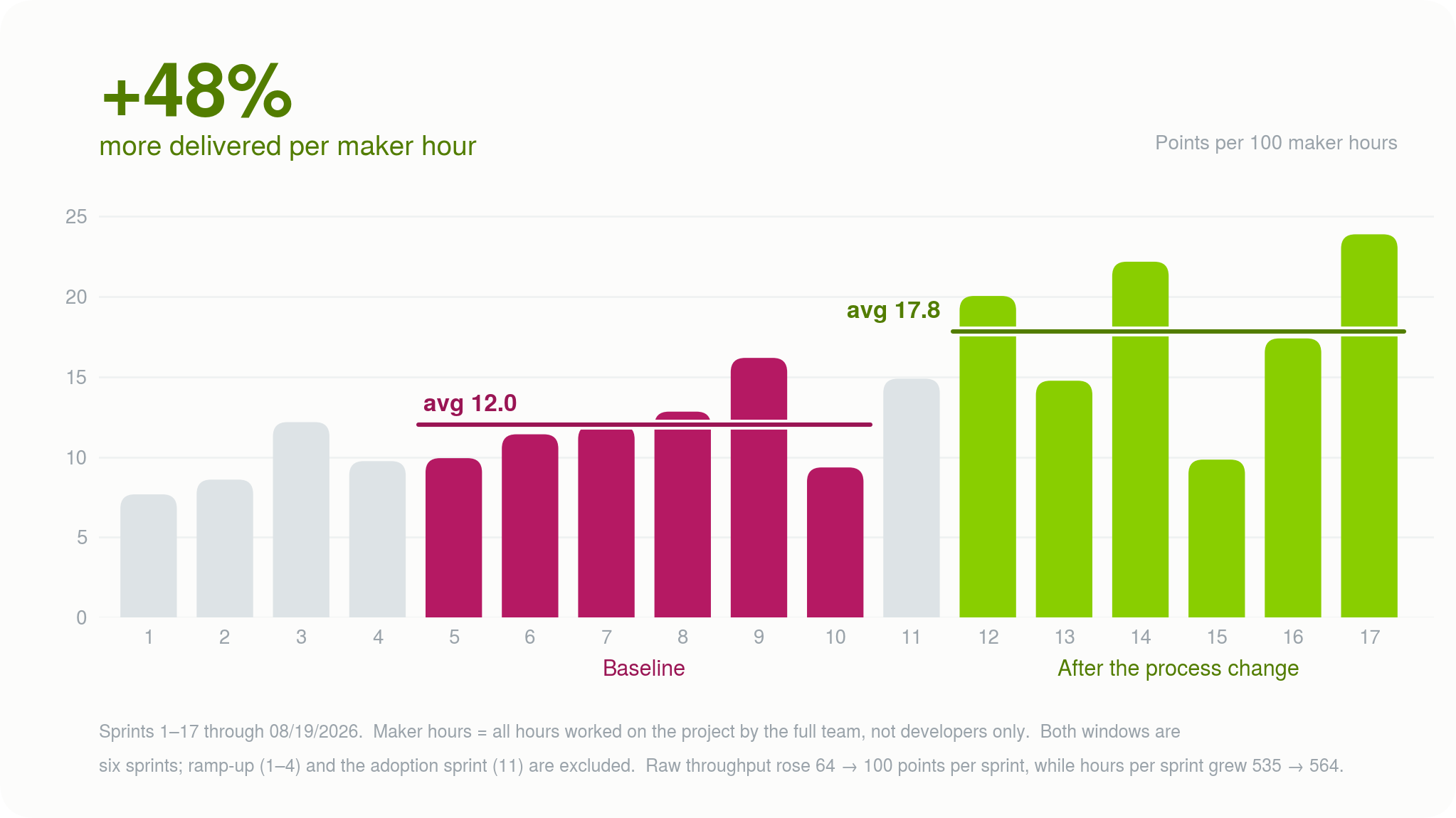

An energy corporation’s multi-year modernization project team layered a new AI process on top of AI tooling. Rebuilding the process around them raised output 48% per hour worked.
more story points delivered per hour worked after the team changed process
of calendar time saved in the project, after the new process
that the gain has held, across changing team size and time off during the ongoing project
Client Outcomes

“What I love about working with the team at Atomic is that they don't want to just build what we tell them to build; they want to provide value and bring their ideas to the table, so it's more efficient, more user-friendly, more helpful.”
A sustained 48% lift in output per hour, achieved mid-project.
Ten sprints into the modernization, the team uncovered larger scope. To proactively address this, the team changed how it worked, rebuilding its delivery process around AI agents over the following sprints. Output rose from 12.0 to 17.8 story points per 100 hours worked and has held there for six sprints. On current pace, the client's software now tracks to arrive roughly two months earlier than the pre-adoption trend.





The gain came from a new process as opposed to new tooling.
Through every baseline sprint, developers already had AI-assisted editors open. Those sprints delivered 12.0 points per 100 hours. What the team lacked was a process built around agents, so it built one, starting with its worst bottleneck rather than with a methodology. The 48% arrived with the process change.
A system of record that can prove what happened, years later.
The assets this platform tracks can only be claimed once, so the sequence of events behind each one is the product. Domain events are stored append-only, with PostgreSQL read models projected from them for everyday screens. Lifecycle rules live with each entity as explicit state machines, and every transaction shares one auditable envelope.
Legacy data moved without inheriting legacy problems.
Inaccurate data contributed to the shortcomings of earlier platforms, so the migration harness reads the legacy database but writes through the new system's own API, with preflight validation, batching, dry runs, and explicit mappings. The new system's rules apply to the old system's data rather than being bypassed to load it.
Validated Reviews from Atomic Clients
See how our clients rate their experience working with Atomic on Clutch. Read verified reviews that highlight our commitment to delivering innovative solutions and exceptional results.